
Choosing a preschool feels a bit like dating. You want chemistry, trust, and someone who won’t lose your kid’s jacket every single day. Luna’s Montessori Bilingual School in Alameda, California, has been that reliable match for local families, offering a Montessori education built around two clear age groups and a couple of standout special programs. Here’s what the school actually offers, minus the fluff.
A Quick Introduction to Luna’s Montessori
Luna’s Montessori sits in a bright Victorian-style building at 1247 Park Avenue in Alameda, CA, with two classrooms full of natural light and a playground out back. The school runs Monday through Friday, from 7:30 am to 5:30 pm, and it stays closed on weekends (your Saturdays are safe).
The core philosophy leans hard on four values: Empathy, Peace, Respect, and Courtesy. It’s a bilingual, family-oriented environment, and the staff teach in both English and Spanish throughout the school day. Parents on Berkeley Parents Network describe the teachers as warm, attentive, and genuinely invested in each child’s comfort during the transition into school life.
Now, let’s break down who the programs are actually for.
Programs by Age Group
Luna’s Montessori organizes its classrooms around two developmental stages. This isn’t arbitrary. Montessori education has always grouped children by sensitive periods of growth rather than by grade level, and Luna’s follows that tradition closely.
2 – 3 ½ Years Old
This age group covers the early toddler years, right when independence starts kicking in (along with a fair amount of “I do it myself!”). Children in this stage work with Montessori materials at a foundational level, alongside arts, sensorial activities, and practical life exercises like pouring, buttoning, and other tasks that build fine motor skills and confidence.
The classroom environment supports language development, social-emotional growth, and early cognitive skills. Teachers guide gently rather than direct constantly, which is the whole point of the Montessori approach. Children learn by doing, not by being told.
3 ½ – 6 Years Old
Once kids move into this stage, the curriculum expands. Expect a mix of science, music, art, mathematics activities, language work, and a cultural curriculum that covers topics like life cycles of animals and plants, geography, holidays, and different countries and cultures. This is often called cosmic education in Montessori circles, and it’s designed to give children a sense of their place in a much bigger world.
Children in this group also get more exposure to Spanish, both formally and informally, setting them up nicely for the school’s signature language program (more on that below).
Across both age groups, the school maintains a one teacher to ten student ratio, which keeps things personal rather than chaotic.
Programa de tardes de inmersión en español
Here’s where Luna’s Montessori really sets itself apart from a typical neighborhood preschool. The Programa de tardes de inmersión en español is a total language immersion experience, meaning children are surrounded by Spanish for the entirety of the afternoon session, not just during a 20-minute circle time song.
Bilingual education has real, well-documented cognitive benefits, including stronger executive function and improved problem-solving flexibility, according to research summarized by the American Councils for International Education. Luna’s Montessori doesn’t just teach Spanish as a subject. Staff are fluent in both English and Spanish, and the language becomes part of daily life rather than a lesson to sit through.
One parent on Berkeley Parents Network shared that her daughter attended the Montessori curriculum from ages 2 to 4 and later stayed enrolled in the school’s Spanish language aftercare program while attending public transitional kindergarten in the mornings. That kind of flexible, layered use of the program says a lot about how the school accommodates real family schedules.
If your child is a toddler in the 2 – 3 ½ years old group, Spanish shows up gently through songs and everyday conversation. By the time kids reach the 3 ½ – 6 years old group, the immersion afternoon program becomes a genuine second-language environment, not just decoration.
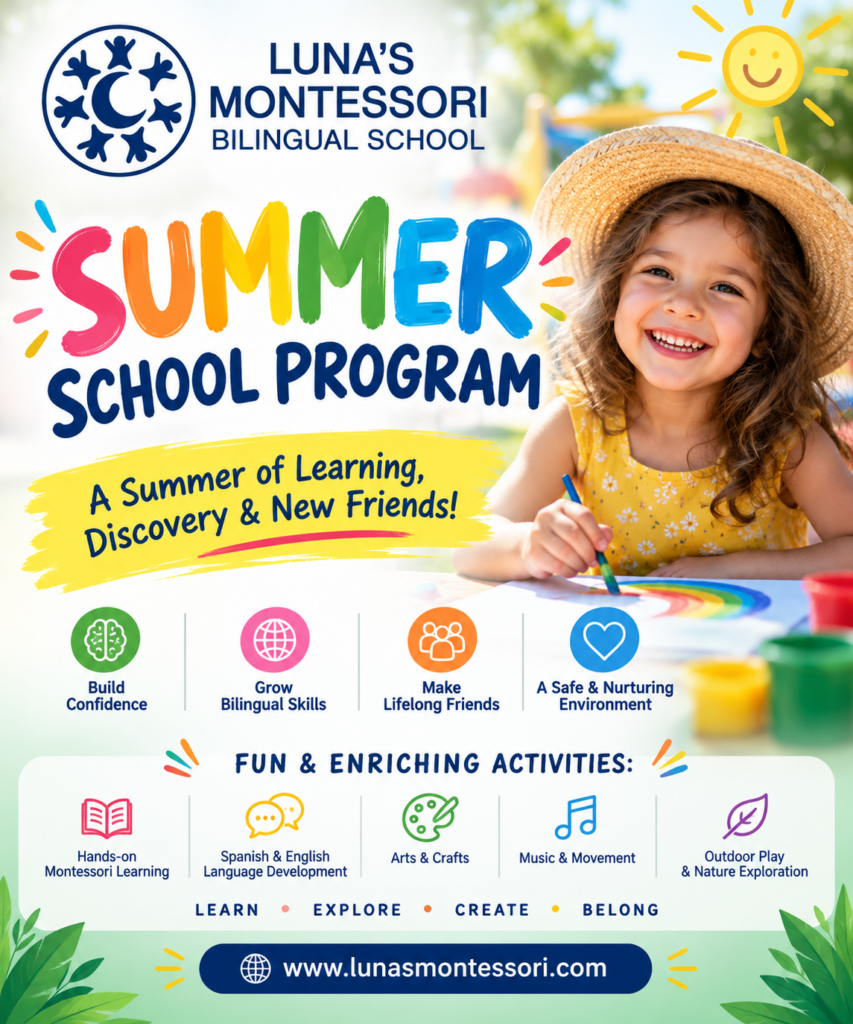
Summer School Program
Summer break doesn’t have to mean four weeks of screen time and negotiating snack requests every twenty minutes. Luna’s Montessori runs its Summer School Program during July and August, giving children a continued, structured Montessori experience during the months when regular programs wind down.
The Summer School Program keeps the same nurturing environment families already know, just with a seasonal rhythm. Tuition for the summer session differs from the standard school-year rates, so it’s worth checking directly with the school for current pricing before assuming your regular plan applies.
Continuity matters in early childhood education. Skills like fine motor coordination, language acquisition, and social behavior benefit from steady practice rather than long gaps, a point echoed by early childhood development research from the National Association for the Education of Young Children (NAEYC). A Summer School Program that mirrors the regular curriculum, instead of turning into unstructured daycare, helps children hold onto the progress they made all year.
What a Typical Day Looks Like
Luna’s Montessori structures each day with intention:
- Morning work period: Roughly 9:30 to 11:30 am, this is the core Montessori work cycle where children choose activities independently.
- Snacks and lunch: Families send up to two snacks and lunch. Morning snack is standard for everyone; kids staying later need lunch and an afternoon snack, served before 3:00 pm.
- Enrichment activities: Botany, geography, movement and music, and practical life work round out the schedule.
- Extended and full-day care: For families needing longer coverage, the school offers care that stretches into the late afternoon.
None of this is groundbreaking on its own. What makes it work is consistency. The same values, the same teachers, and the same bilingual thread run through the entire day, whether a child is in the 2 – 3 ½ years old room or the 3 ½ – 6 years old room.
Why Families Choose Luna’s Montessori
Parents don’t just enroll their kids and disappear. Feedback collected on platforms like Berkeley Parents Network and Winnie consistently mentions a few things: teachers who stay late to talk through a child’s needs, a smooth adjustment period thanks to built-in transition days, and a genuine sense that the staff care beyond the paycheck.
One parent noted her son thrived “mentally, emotionally, and physically” during his time at the school and felt confident he’d be ready for kindergarten. Another appreciated having a small Spanish speaker at home by the end of the year, which, frankly, is a pretty solid bonus for a preschool experience.
How to Enroll or Schedule a Tour
Luna’s Montessori accepts applications with a non-refundable $200 fee, and tours are available before enrollment so families can see the classrooms, meet staff, and ask questions about the specific age group that fits their child. Since spots can fill up well before the school year starts, reaching out early is a smart move, especially if you’re interested in the Spanish Immersion Afternoon Program or the Summer School Program, both of which tend to draw extra interest.
Frequently Asked Questions
Parents researching preschools tend to Google the same handful of questions at 11 pm, usually right after putting a toddler to bed. Here are the ones that come up most.
What ages does Luna’s Montessori accept? Luna’s Montessori enrolls children from 2 to 6 years old, split into two classrooms: 2 – 3 ½ years old and 3 ½ – 6 years old. Each room is designed around what kids at that stage actually need, rather than cramming every age into one space.
Does my child need to be bilingual or already speak Spanish to enroll? No. Many enrolled families speak only English at home. Spanish is introduced gradually through songs, conversation, and the classroom routine, and it ramps up further in the Spanish Immersion Afternoon Program. Kids pick it up the way they pick up everything else at that age: by absorbing it.
Does my child need to be toilet trained? Most Montessori primary programs, including classrooms serving the 3 ½ – 6 years old age group, expect children to be toilet trained or actively working toward it. It’s best to confirm the specific requirement directly with the school, since policies can vary by classroom and age.
What schedule options are available? Luna’s Montessori offers half-day (roughly 9:00 am to 12:00 pm), extended day (roughly 9:00 am to 3:00 pm), and full-day (7:30 am to 5:30 pm) schedules, with two to three day per week options available depending on the program. This flexibility helps families who don’t need full-time five-day care.
When does the Summer School Program run, and is it different from the school year? The Summer School Program runs during July and August. It follows the same Montessori structure as the regular school year but on a seasonal calendar, and tuition for summer differs from standard monthly rates, so it’s worth confirming current pricing directly with the school.
How does the Spanish Immersion Afternoon Program actually work day to day? Rather than a scheduled “Spanish lesson,” the afternoon session is conducted with Spanish as the primary language of instruction and conversation. Teachers are fluent bilingual speakers, so children hear and use Spanish naturally throughout activities, not just during a set block of vocabulary practice.
Is Luna’s Montessori accredited or licensed? Yes. The school is licensed by the California Department of Social Services and is a full affiliate member of the American Montessori Society (AMS), with lead teachers holding AMS certification. That combination of state licensing and Montessori accreditation is a good baseline to check for any Montessori preschool you’re considering.
What is the teacher-to-student ratio? Luna’s Montessori maintains a ratio of one teacher for every ten students, which keeps group sizes small enough for individualized attention.
How much does tuition cost, and is there an application fee? Tuition is quoted monthly and varies by schedule (half-day, extended day, or full-day) and by how many days per week a child attends. There’s a non-refundable application fee due before touring, and the school can provide a full pricing packet on request. Contact the admissions office directly for current numbers, since these figures are updated for each school year.
How do I schedule a tour or start the enrollment process? Reach out through the school’s contact email or phone line to request a tour and an enrollment packet. Since spots, especially in the more popular age brackets and the Spanish Immersion Afternoon Program, tend to fill up before the school year starts, it helps to inquire several months ahead.
Final Thoughts
Luna’s Montessori offers a genuinely structured, bilingual approach to early education, split cleanly between the 2 – 3 ½ years old and 3 ½ – 6 years old programs, with the Spanish Immersion Afternoon Program and Summer School Program adding real depth beyond the standard school year. It’s not flashy marketing. It’s a small Alameda school doing the fundamentals well, and letting the reviews speak for themselves.
If you’re weighing your options, a tour tells you more in twenty minutes than any webpage ever could. But hopefully, this one got you most of the way there.

 Spanish
  English